Wednesday, October 5, 2011

Just Words

Joe - Djibouti (I’m in Bahrain now but thinking back) – We got off the plane in Djibouti and had to get visas attached to our passports to enter the country. We were sent to an office to meet with the customs officer who interviews foreigners for entry visas.

Johnny showed the officer our tour book which describes the details of our visit to each country - where we stay, embassy contacts, concerts, master classes etc. The conversation, in English, got bogged down. The officer acted a bit confused and annoyed. The situation was getting a little tense. There seemed to be confusion over our purpose in Djibouti. Were we in Djibouti to play at the American embassy or on behalf of the American embassy? French is one of the official languages of Djibouti so I decided to jump into the conversation to see if my fairly decent French accent, bad grammar and horrible vocabulary would help. Et voila! The customs official’s attitude completely changed. In a minute or so he was laughing. I told him how I learned French (I leave that story for another place and time – it’s complicated).

I thought about this experience over the next few days. What happened? I believe that this was an experience that can be easily misinterpreted. Before having spoken French to him it was easy for me to think, “Okay, this guy’s giving us a hard time because we’re Americans. Foreigners hate Americans”. I hear that a lot in the States these days. But, what I really believe now is that he was as uncomfortable speaking English as I am speaking French. When I spoke French, even bad French, the world shrunk. His English was probably better than my French but I could tell that he appreciated the effort on my part. I think he was actually happy to meet a bunch of smiling American musicians making silly jokes in his office.

As a side note I should say that it’s not uncommon to meet Djiboutiens who speak at least four languages fluently. Arabic and French are official languages in Djibouti while many people are also fluent in Somali and Afar. English is also widely spoken with varying degrees of proficiency. It’s humbling for me, an American who speaks one language and struggles by in a second language, to meet a Djiboutien kid who can switch in and out of four languages depending on the conversation.

Language is interesting in the sense that it can separate us as people or bring us together. Words can be tricky – to play at a place (an embassy) or on behalf of an entity (an embassy) is a subtle distinction if you are not speaking your own language. In fact, I’m getting a head ache thinking about this. I’ll leave this to linguists.

In the end, I believe that we would have gotten our visas a lot faster if we had just played “Hit the Road Jack” for the customs officer. But then again, I wouldn’t have gotten the free French lesson.

The Horn Of Africa


CREATION
IMPROVISATION
EDUCATION
CONVERSATION
COLLABORATION
INNOVATION
MUSICALIBERATION


Johnny:  DJIBOUTI

(Photos by Staff Sgt. Renae Saylock USAF)

You can tell a lot about a human spirit by the sound and tone that comes out of their instrument.  Some players are more lyrical and sweet, some more aggressive and edgy.  Tone, when it is truly unique and personal, is somewhat like a fingerprint, in that no two players sound exactly the same.

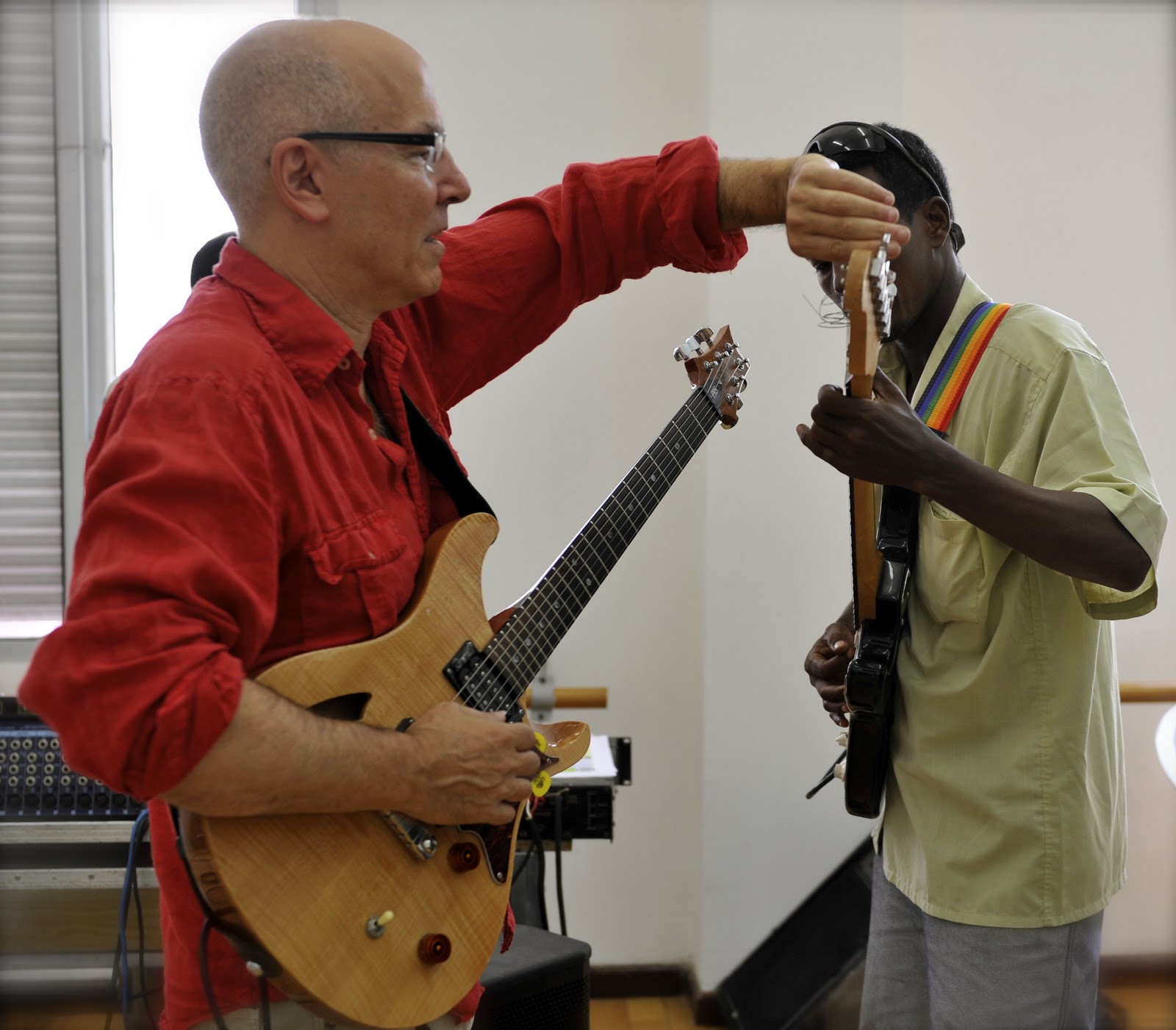
I encouraged the students at the Arts Center in Djibouti to bring their instruments to the master class.  Two students complied.

Although we certainly involved everyone with clapping, call and response, and vocal improvisations, these two students joined us instrumentally in our musical jam sessions.


The first was a guitar player and vocalist who shared a traditional local song with the class.  He had 5 strings on his electric guitar, but played them with the joy of all 6.  He led us in his own unique version of Ray Charles’ “Hit The Road, Jack,” which seems to be a favorite throughout the region, and Joe provided him with a full set of new strings for his guitar, a difficult thing to find in town.  This city has a high level of poverty and the equipment that is available to the local musicians is largely provided by US soldiers at Camp Lemonnier, a US Navy installation nearby.  Many of these soldiers are going above and beyond the call of duty to create opportunities for musical and arts educational programs to the local students.


The master class continued and one student was overcome with rhythm and began joyfully dancing to the beat.  I learned a few new moves!


Then something unexpected happened.  One of the only female students in the class, a woman in beautiful pale green clothing and scarves pulled out a tenor saxophone.  Her conservative dress were a stark contrast to the large horn she held in her hand.  I asked her to join us and she said she only played alone.  I said that would be fine, but she changed her mind.  After a bit of gentle coaxing, she finally agreed to come to the front and play.
She approached shyly and raised the mouthpiece to her lips, looking around somewhat nervously.  It’s very possible that she had never played in public before this moment.
She took a breath and blew into the horn.  A squeak...then a squawk.  Frustration crossed her face.
“It’s fine,” I assured her.  “There are no wrong notes.  Play what you feel.”
She redoubled her efforts, moistening the reed a bit more, looking around the room tentatively.  Then something clicked.  I saw something change in her eyes.


She took a deeper, more courageous breath, and then...
Out came a sound that was broad and clear.  She played a minute or two solo and her confidence grew with every passing note.  She soon seemed to forget her surroundings completely and tap into the source.


The band joined in with her and she played with a robust tone akin to a young John Coltrane.  I could hardly believe it, and I was loving every moment.
At one point she left the melody far behind and played with complete freedom, a musical self-expression of spirit that refused to be pinned down by any form or key signature.  True. Free. Jazz.


Finally, she opened her eyes, took the horn out of her mouth and I could see she was finished playing.  She shyly nodded to us and the entire room broke into applause. 
She quietly sat and put her horn away.

I have tremendous respect for her courage.  I wish her many more opportunities to play out with passion and with others in a public forum. 

Something special happened in that room,
Something I have yet to fully understand,
Something I am honored to have been a part of...

Tuesday, October 4, 2011

Jordan encore

Danny; Amman Jordan

After our amazing trip to Petra, on this fortuitous return to Jordan, we had the privilege to play four more events. We returned to the Al Hussein Cultural center for an encore performance. We had the honor to perform for the Prince Ra'ed and Princess Majda as well as US Ambassador Jones and his family.
We got to see some of our fans from our previous trip and some of our new Iraqi friends. It seems that people like to have their pictures taken sitting at my drums.
Earlier in the day, we played an event at a youth recreation center in Amman. The students were conducting interviews with us and asking some important questions about our trip and the music we shared.
In between the shows we went to a cafe/hooka bar for lunch. Lipton is the tea of choice over here and smoking Shishah is a favorite pastime during and after a meal. I bought a beautiful portable hooka to bring home with me.

The next day we played at the Princess Basma youth center in Aaman, but before the concert, Reem, our wonderful translator and event coordinator from the embassy, took us to a conservancy cafe that overlooked the Citadel and Roman ruins.
We had played at another Princess
Basma youth center in Irbid during our first visit to Jordan. It was wonderful to talk to the students and mentors about their facilities and projects. There are clubhouses all over the world and we spoke about staying in touch via webcast from their NYC clubhouse. They gave us some mix CD's that they made snd they were doing some great computer generated art.
Beautiful rosemary bushes were growing outside both centers we had visited.
We played a concert on a stage in their parking lot. They set up chairs and a homemade camera boom that they made from recycled materials.
The concert was so much fun and we played until the sun set. They turned on some car headlights and we continued to play into the evening. Some of the students posed with us after the concert for a group shot.
After a nights rest, we drove to Madaba, which means mosaic. There is a church there called St. Gregory,which is famous for it's beautiful mosaics. There is one on the floor near the altar. We played a concert at the St. George school community center. The concert was great and we had so much fun playing for the Madaba community.
Madaba reindeer;)

Joe Jammin out on Accordion
I heard what he was trying to do.
Never quite heard anything like it;)
Before the concert we had an amazing meal at this wonderful open air restaurant.
We drove back to Amman after the concert and packed for our flight to Bahrain. Everyone at the US Embassy; Ambassador Jones, Karin, Reem, our wonderful drivers, the Jordanian government and all the beautiful people we met in Jordan, made this one of the most wonderful experiences of our lives. I will always carry a part of Jordan with me in my heart and I will forever have Jordan on my mind.

Monday, October 3, 2011

Into the Heart of Petra; Horse with no Name part 2

After our two hour ride on our horses through the highland rocks above the canyon floor of Petra, we started our descent by foot into the valley. We hadn't expected to travel this route, so none of us had worn shoes that would make this decent easier. We climbed down the first path until we reached a plateau where we met a Bedouin woman who offered us some tea. She had a small table and tent where she sold camel bone jewelry and other beautiful trinkets.
We bought some presents, had some tea with her and her cats and then continued on the path until we saw another tent with more jewelry.
Another Bedouin woman showed us her goods and introduced us to her cats and her Donkey named Susan.

She had some donkey milk in a bottle and told us how it healed a local child who couldn't talk. They had seen many doctors, but after a shaman told them to feed the boy donkey milk for six days, the boy began to speak. I think his first words were probably, " Please, no more donkey milk" ;)


We bought some more presents and talked for a while with the woman. She suggested we go up this path to a great view of the valley and a sacrifice site. The path was lined with more Bedouin women who were selling trinkets and they seemed to be strategically placed along the path to the best views;) We got to the top and we were not disappointed with view.

We went back down the path past all the tented tables and when I was saying goodbye to the woman who told us the donkey milk story, she cemented that she really liked my necklace. I took off the polished beaded shells from around my neck and handed it to her. I told her it came from the Solomon islands near Papeau New Guinnea and that they were like wampum beads used for trading. I had gotten them on our last State Dept. tour of South East Asia. In refurn, she gave me a camel bone necklace that she had made and when I put it on, I had yet another reminder of this amazing day and trip to the Middle East. We still had a long way to go and she showed us the path that would lead to the 800 steps that would take us to the valley below.

It took a long time to follow the carved rock stairs down into the floor of the canyon and our legs were getting tired from the climb down as well as the long ride. The rock formations and the colors were beautiful under the late afternoon sun.

As we got closer to the canyon floor, you could start to see the cave dwellings and burial niches carved into the rock. The pictures don't really give you the sense of how big and wide the view is to the human eye. It is so expansive, that it seems surreal. The mind has no reference for anything that big and spacious. It seems like you are looking at a painting or a film. Here there is a sense of wonder, a sense of timelessness and words can only point to the stillness that it creates in you.

We reached the canyon floor and were dwarfed by the rock walls that lined the valley. The colors were changing by the minute, as the sun moved across the sky.

We stayed in the area by the front of the treasury, taking pictures of camels and the carved rock structures. We sat, had some water, talked about the journey so far and how lucky we were to be able to do a trip like this. I feel so blessed to be able to play music around the world for so many people. I am thankful to have made so many new friends.

We gathered our strength and started walking through the narrow walled canyon path back to the town.

On the way we saw some tombs/living spaces carved into the rock. We walked the final mile and at one point we stopped to listen to the beautiful acoustics and sound reflecting off the rocks.

We finally made it back to the car and our wonderful driver Hasan, had set up a nice spread of cheese, bread and vegetables in his trunk.

I can't believe what an incredible adventure we had that day. We are all changed because of that journey through the heart of Petra. There will be more pictures and stories to come about this day, from the other guys.
I feel I understand a little more about Jordan and a lot more about myself.
I hope everyone back home gets a chance to come here some day, it is a wonder indeed and the warmth of the people can't even be eclipsed by the warmth of the beautiful sun in the ever blue sky above Petra:)